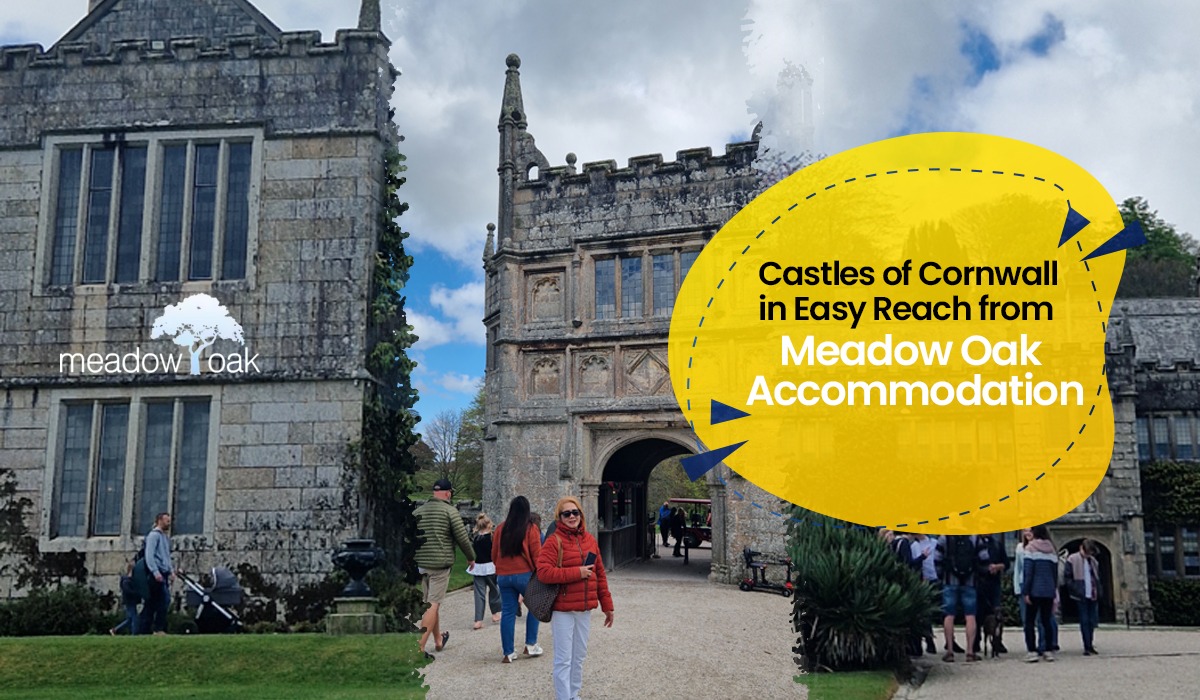
Castles of Cornwall in Easy Reach from Meadow Oak Accommodation
A comprehensive guide to the most spectacular, historic, and atmospheric castles in Cornwall — all within striking distance of your Bodmin base
Cornwall is castle country. From the windswept Arthurian ruins of Tintagel clinging to their north coast cliffs to the perfectly preserved Tudor artillery fortresses guarding the Fal estuary, this ancient duchy has been fortified, defended, and embattled for over a thousand years. Staying at Meadow Oak Accommodation on Lostwithiel Road in Bodmin places you at the geographic heart of Cornwall — meaning that Cornwall’s most extraordinary castles are never more than an enjoyable drive away.
Whether you’re a history enthusiast, a legend hunter chasing the ghost of King Arthur, a family looking for the perfect adventure day out, or simply someone who appreciates dramatic architecture in breathtaking settings, the castles of Cornwall will not disappoint. In this guide, we take you through eleven of the finest Cornish castles that are well within reach from your Meadow Oak base — covering their history, what to see, practical visitor information, and tips for getting the most out of each visit.
1. St Mawes Castle
Perched on the southern tip of the Roseland Peninsula across the Fal estuary from Falmouth, St Mawes Castle is widely considered to be one of the most beautiful and best-preserved of all Henry VIII’s coastal fortresses. Built between 1540 and 1545 as part of the king’s ambitious programme of coastal defence against potential Catholic invasion from France and Spain, St Mawes was designed to work in concert with its sister fortress, Pendennis Castle, to provide overlapping fields of fire across the Carrick Roads — the large natural harbour at the mouth of the River Fal.
The castle’s distinctive cloverleaf design — a large round tower above three circular bastions — is utterly unlike anything else built in England during the Tudor period, and has made it one of the most recognisable and photogenic castles in the country. What makes St Mawes particularly remarkable is how little it was altered after its original construction, meaning that visitors today see essentially the same fortress that Henry VIII would have known.
Inside, the castle is lavishly decorated compared to its purely military counterpart at Pendennis. Carved Latin inscriptions in praise of Henry VIII and his son Edward VI still adorn the stonework, and the interior rooms have been thoughtfully furnished and interpreted by English Heritage. There’s a reconstructed gun platform, a fascinating kitchen, an ‘oubliette’ (a deep pit where troublesome prisoners were kept), and an engaging audio tour that brings the castle’s history to life.
The surrounding gardens are beautifully maintained, and the views across the estuary to Pendennis and Falmouth are simply outstanding. After your visit, the pretty village of St Mawes below the castle is well worth exploring — there are excellent restaurants, a small beach, and a regular ferry service to Falmouth that makes a wonderful added excursion.
Getting there from Meadow Oak: Approximately 35–40 minutes by car, heading south towards Truro and then east along the Roseland Peninsula. Consider taking the King Harry Ferry across the Fal for a scenic and memorable approach.
2. St Catherine’s Castle, Fowey
Tucked into the rocky headland above the entrance to Fowey Harbour, St Catherine’s Castle is a lesser-known gem that rewards the effort required to reach it with spectacular views and a genuine sense of discovery. Built by Henry VIII between 1538 and 1542 — at roughly the same time as Pendennis and St Mawes — St Catherine’s served as an artillery fort to defend the important port of Fowey from seaborne attack.
The castle is now largely a ruin, but the two remaining gun towers are still impressive, and the views across Fowey Harbour, Polruan, and the Cornish coastline are among the finest in the county. The castle was later modified during the Crimean War with the addition of a two-gun battery, and again during the Second World War when it was used as an ammunition store and anti-aircraft position.
Importantly, St Catherine’s Castle is free to visit — though reaching it requires a pleasant walk of approximately 20 minutes through the National Trust’s Readymoney Cove woodlands from the car park in Fowey. Readymoney Cove itself is a delightful small beach that is perfect for a swim or picnic, making the whole excursion a wonderfully rewarding half-day out. You can also take a boat trip up the River Fowey from the town quay to see the castle from the water.
Getting there from Meadow Oak: Approximately 20–25 minutes south via Lostwithiel. Fowey is a beautiful destination in its own right, with excellent restaurants, galleries, and a rich literary heritage (it was home to Daphne du Maurier).
3. Pendennis Castle, Falmouth
If St Mawes is Tudor Cornwall’s prettiest castle, then Pendennis Castle is its most formidable. Built on a dramatic headland above Falmouth harbour between 1539 and 1545 on the express orders of King Henry VIII, Pendennis was designed to be the dominant fortress guarding the Carrick Roads — a natural harbour so large it could theoretically shelter the entire Royal Navy.
The castle we see today is far more extensive than Henry’s original round gun tower, having been substantially strengthened and expanded by Queen Elizabeth I in the 1590s in anticipation of further Spanish attack following the Armada of 1588. The outer bastioned defences — a massive star-shaped wall encircling the original Tudor tower — were added at this time, and it is this combination of Tudor and Elizabethan military architecture that makes Pendennis one of the most historically layered and fascinating fortresses in the south-west.
During the English Civil War, Pendennis was one of the last Royalist strongholds in England to surrender to Parliamentary forces, holding out for a remarkable five months under siege in 1646 before the garrison finally capitulated due to starvation. The castle also served as an important military base during both World Wars, with the site containing gun batteries, searchlight positions, and a coastal observation post from the Second World War that visitors can still explore today.
There is a huge amount to see and do at Pendennis. Visitors can climb the original Tudor keep for panoramic views across Falmouth Bay and the Fal estuary, explore the World War II exhibition in the Half Moon Battery, wander through the vast castle grounds with their original cannons, and enjoy costumed interpretation events during the summer months when historical characters bring the castle to life. The café in the Barrack Block serves excellent food including locally sourced crab, scones, and Cornish cream teas.
Getting there from Meadow Oak: Approximately 35–45 minutes southwest. After visiting Pendennis, consider catching the ferry across the estuary to St Mawes to visit both Tudor fortresses in a single day.
4. Restormel Castle, Lostwithiel
The closest major castle to Meadow Oak Accommodation is arguably also the most architecturally perfect. Restormel Castle near Lostwithiel is a magnificent example of a circular medieval shell keep — and it is, according to many historians, the finest surviving example of this type of castle in the entire country.
The original wooden motte-and-bailey castle on this site was built shortly after the Norman Conquest of 1066, but the great stone shell keep that survives today was built in the early 14th century by the Earls of Cornwall as a luxurious aristocratic retreat rather than a purely military fortress. In 1337, the castle was granted to the Black Prince — Edward of Woodstock, eldest son of Edward III — who became the first Duke of Cornwall and used Restormel as an important base for administering the Duchy and the Cornish tin stannaries.
During the English Civil War, Restormel was briefly garrisoned by Parliamentary forces before falling into disuse and eventual ruin. Today, the dramatic circular shell keep still stands to a remarkable height, and walking along the inner walls and through the traces of the former great hall, chapel, and private chambers gives visitors a vivid sense of the castle’s former grandeur. The elevated position provides sweeping views over the River Fowey valley and the beautiful wooded countryside beyond.
The castle grounds are managed by English Heritage and the surrounding parkland is lovely, particularly in spring when the wildflowers and rhododendrons are in full bloom. This is an ideal picnic spot. The pretty town of Lostwithiel is just a short walk away and is well worth exploring for its excellent independent shops, artisan food producers, and the beautiful medieval bridge over the River Fowey.
Restormel is so close to Meadow Oak that it makes a perfect easy half-day excursion, and we consider it one of the essential Bodmin-area experiences.
Getting there from Meadow Oak: Less than 5–10 minutes south via Lostwithiel Road. Free car park on site.
5. Tintagel Castle
Perhaps the most dramatically situated and romantically storied castle in all of England, Tintagel Castle on the north Cornwall coast is a place of genuine wonder. Perched high on a rugged coastal headland, separated from the mainland by a narrow chasm above crashing Atlantic waves, Tintagel has been associated with the legend of King Arthur since at least the 12th century — and the power of that association is impossible to resist even in the cold light of archaeological scrutiny.
The ruins we see today date primarily from the 13th century, when Richard, Earl of Cornwall — brother of King Henry III — built a castle on a site that had already been used by the ancient Cornish kingdom of Dumnonia. Archaeological excavations in recent decades have revealed that Tintagel was a significant high-status settlement in the 5th and 6th centuries AD — exactly the period when the historical Arthur (if he existed) would have lived.
A spectacular new bridge connecting the mainland section of the castle to the island was opened in 2019, dramatically improving access to what was previously a very challenging site. Standing on this bridge, with the Atlantic crashing 100 metres below and the vast Cornish sky above, is one of the most memorable experiences in the county. The island itself contains the remains of the medieval castle buildings, stunning coastal views in all directions, and access to the beach below where Merlin’s Cave can be explored at low tide.
Look for the remarkable Gallos statue — an 8-foot bronze figure standing at the island’s highest point, its face eroding like the cliffs around it. The statue’s name means ‘power’ in Cornish and was inspired by Tintagel’s royal past.
Tintagel village is a charming place to spend time before or after your castle visit, with excellent Cornish pasty bakeries, independent shops, and a fantastic range of Arthurian-themed attractions and experiences.
Getting there from Meadow Oak: Approximately 45–50 minutes north via the A39 or A395. Allow a full day including travel.
6. St Michael’s Mount, Marazion
One of the most iconic images in all of England, St Michael’s Mount rising dramatically from the waters of Mount’s Bay near Penzance is a sight that stops visitors in their tracks every single time. This tidal island, topped by a medieval castle and priory, is joined to the mainland village of Marazion by a cobbled causeway that is accessible on foot at low tide — making every visit feel like a genuine adventure.
A Benedictine priory was established on the Mount in the 12th century, and a fortified castle gradually developed around it over the following centuries. The magnificent castle at the summit — which has been the family home of the St Aubyn family since the mid-17th century — contains a remarkable collection of armour, art, and antiques, as well as a series of rooms that offer extraordinary views over the bay in every direction. The subtropical gardens cling to the rocky slopes below the castle and are a genuine horticultural achievement, given the challenges of the salt-laden winds and steep terrain.
At high tide, St Michael’s Mount becomes a true island and can be reached by a small passenger ferry from Marazion. At low tide, the causeway crossing on foot is a wonderfully atmospheric experience. The village of St Ives, the ancient Minack Theatre at Porthcurno, and the famous Porthcurno beach are all within easy reach, making a visit to the far west of Cornwall a brilliant full-day or even overnight excursion from Meadow Oak.
Getting there from Meadow Oak: Approximately 60–75 minutes west via the A30. Best combined with a visit to Penzance, St Ives, or the Lizard Peninsula.
7. Launceston Castle
Gateway to Cornwall from Devon, Launceston Castle is one of the most historically significant and visually distinctive fortresses in the county. Sitting atop a commanding mound at the centre of the town of Launceston — the ancient capital of Cornwall before Bodmin took over that role — this castle has dominated this strategic crossing point on the River Tamar for over a thousand years.
The castle we see today is primarily 13th century, when Richard, Earl of Cornwall constructed the unusual round tower that sits inside a circular shell keep on the castle mound. The combination of a round tower inside a circular shell keep is highly unusual in English castle architecture and gives Launceston a distinctive and immediately recognisable silhouette. Earlier Norman earthworks and a motte-and-bailey precede this stone construction, and archaeological investigations have found evidence of use going back even further.
Launceston Castle served for many centuries as the administrative and legal centre of Cornwall, as well as a prison with a particularly colourful and often grim history. Among its famous inmates was the Quaker founder George Fox, imprisoned here in 1656. The exhibition inside the castle traces over 1,000 years of this remarkable history, including displays of finds from archaeological excavations on the site and a newly redesigned exhibition (2022) featuring never-before-seen objects from the castle collection.
Brave the dark and rather steep internal staircase to emerge at the top of the tower for genuinely impressive views across Launceston and the surrounding countryside into Devon. The town of Launceston itself is well worth exploring — the pretty square, the Norman church of St Mary Magdalene (with its extraordinary carved granite exterior), and the excellent independent shops make for a rewarding afternoon.
Getting there from Meadow Oak: Approximately 30–35 minutes northeast via the A30.
8. Chun Castle, West Penwith
For those who want to explore something altogether different — an ancient Iron Age hillfort that predates the Norman castles by nearly two thousand years — Chun Castle on the remote Land’s End Peninsula offers a genuinely atmospheric and haunting experience. Perched on the high moorland of West Penwith near Morvah, Chun Castle is a remarkable double-walled circular Iron Age hillfort, probably constructed around 200 BC and reoccupied during the post-Roman period.
The site is free to visit and can be reached by a pleasant moorland walk from the road near Morvah. The views from inside the fort across the rugged Penwith landscape to the sea are exceptional, and the site is rarely crowded, giving visitors the rare pleasure of experiencing an ancient monument in genuine solitude. Nearby is the extraordinary Chun Quoit — a Neolithic portal dolmen dating back some 5,000 years — which adds to the sense of layered time that permeates this part of Cornwall.
Getting there from Meadow Oak: Approximately 60–70 minutes west. Best combined with a wider exploration of the Land’s End Peninsula, including the Men-an-Tol, St Just, and Cape Cornwall.
9. Caerhays Castle & Gardens
Standing in a romantic Gothic Revival splendour above Porthluney Cove near Mevagissey, Caerhays Castle is one of the most beautiful country house castle estates in Cornwall. Designed by the great Regency architect John Nash — designer of Buckingham Palace and Brighton Pavilion — Caerhays was built for the Trevanion family in the early 19th century and has been owned by the Williams family since 1853.
The estate is principally famous for its extraordinary garden, which contains the largest collection of magnolias in the UK as well as outstanding collections of azaleas and camellias among its 600-plus plant varieties. The Williams family have been passionate plant hunters and horticulturalists for generations, and their legacy is a garden of world-class importance that is at its absolute peak in spring. The castle interior — open for guided tours from mid-March to mid-June — is a fascinating glimpse into the life and collections of a Cornish landed family, with Victorian and Edwardian artefacts lovingly preserved throughout.
The private beach at Porthluney Cove, visible from the castle’s drive and grounds, is one of the most beautiful and uncrowded beaches on Cornwall’s south coast, making Caerhays a perfect combined visit.
Getting there from Meadow Oak: Approximately 35–45 minutes south via St Austell.
10. Doyden Castle, Port Quin
Doyden Castle is something of a delightful curiosity among Cornwall’s historic fortifications. This early Victorian folly near the tiny hamlet of Port Quin on the north Cornwall coast was built in the 1820s by a gentleman named Samuel Symonds as a private retreat for entertaining — a place to escape to, enjoy good wine, and take in the extraordinary coastal views. It was never intended as a defensive structure, but its turreted, castellated appearance makes it look convincingly like a miniature castle from a distance.
Today, Doyden Castle is managed by the National Trust as a holiday property — meaning that if you want to experience its legendary views up close, you’ll need to book a stay. However, even from the dramatic coastal path nearby, the castle makes a wonderful sight perched on its rocky headland above the hidden valley of Port Quin. Port Quin itself is a tiny, beautiful, almost impossibly peaceful cove — a world away from the popular tourist beaches a few miles along the coast.
The castle also gained wider fame as a filming location for the TV series Doc Martin, giving it an extra layer of cultural interest. Port Isaac — home to the fictional Portwenn in the same show — is just a few miles along the coast and makes an excellent combined visit.
Getting there from Meadow Oak: Approximately 40–45 minutes north via Wadebridge.
11. Acton Castle, Perranporth
Acton Castle near Perranporth is another of Cornwall’s more eccentric castle-style buildings — a grand Regency house built in the 1770s on the clifftops above the dramatically beautiful stretch of coast near St Agnes. While it lacks the medieval military credentials of many castles on this list, Acton Castle is a fascinating example of the Georgian taste for gothic and castellated architecture, and its setting above one of Cornwall’s most spectacular stretches of coastline more than justifies a visit to the area.
The wider St Agnes Heritage Coast is outstanding — ancient tin mining engine houses cling to the clifftops, the South West Coast Path offers world-class walking in every direction, and the beaches at Perranporth and Chapel Porth are among the finest on Cornwall’s Atlantic coast.
Getting there from Meadow Oak: Approximately 40–50 minutes northwest via the A30.
Plan Your Cornish Castle Tour from Meadow Oak
Cornwall’s castles span nearly three thousand years of human history — from prehistoric hillforts to Iron Age fortifications, Norman shell keeps, Tudor coastal artillery, and Victorian Gothic follies. Each one tells a different story, and together they paint a vivid picture of the struggles, ambitions, and passions of the people who built and lived in them.
Meadow Oak Accommodation in Bodmin is perfectly placed at the heart of Cornwall to serve as your base for a castle-focused tour of the Duchy. With Restormel Castle virtually on our doorstep, Launceston and Tintagel to the north, St Mawes and Pendennis to the south, and the dramatic far west accessible in under an hour and a half, you can plan a different castle itinerary for each day of your stay.
We offer flexible accommodation options to suit all types of visitors. Our short breaks are ideal for a castle-focused weekend getaway, while our long stays allow you the time to visit every castle on this list at a leisurely pace. Couples will love our romantic breaks package — and what could be more romantic than watching the sun set over the ancient battlements of a Cornish castle?
Visit our places to visit page for further inspiration, and explore our facilities to see everything we offer to make your stay as comfortable and memorable as possible. Our bed and breakfast option ensures you start each castle-hunting day with a hearty and satisfying breakfast.
Book your Cornish castle adventure today at Meadow Oak Accommodation